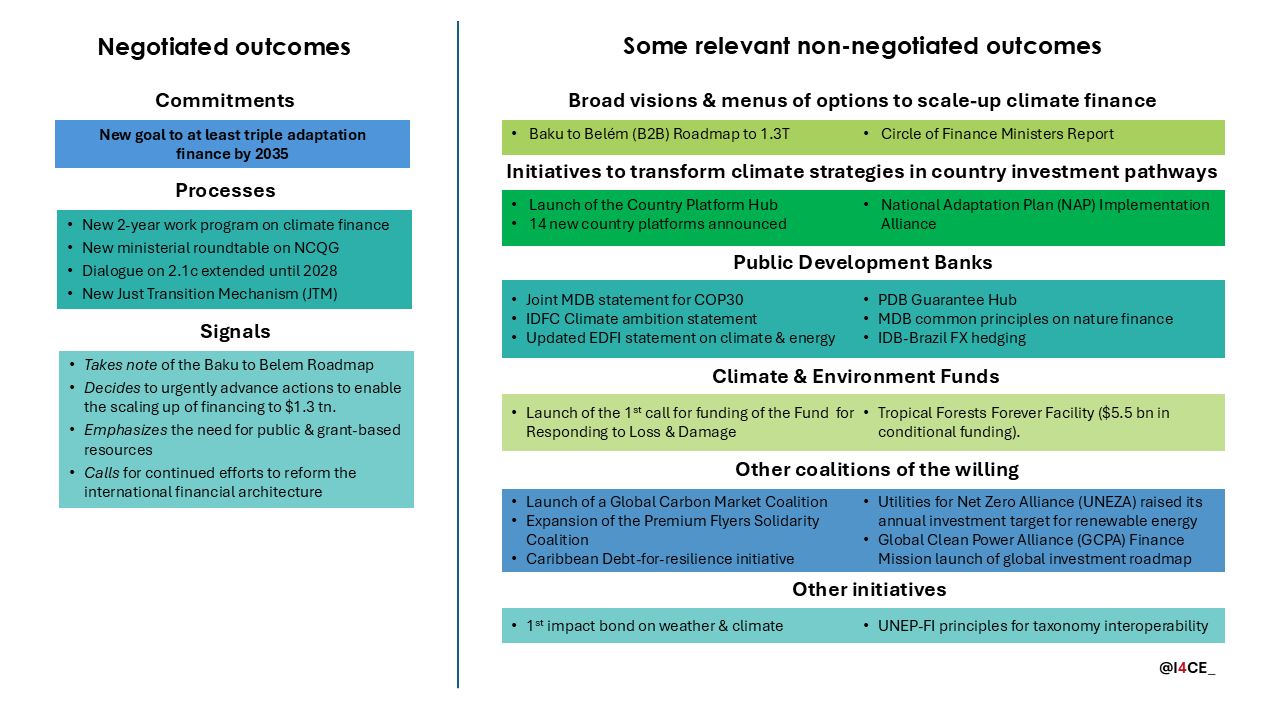
In this newsletter, we are taking a moment to reflect on finance for energy transitions whilst reviewing developments from the last quarter of 2025 and key topics for 2026.
On 12th of December 2015, the Paris Agreement was adopted, obliging governments worldwide to strive to limit global warming to 1.5 °C above pre-industrial levels. In the same year, the 2030 Agenda for Sustainable Development was adopted. 10 years later, the international climate agreement has shaped and accelerated energy transitions at state and non-state actor levels. However, the current rate of global warming and Nationally Determined Contributions of developed economies make it challenging to align with a 1.5 °C pathway.
Urgent financing innovations are critical to close the funding gap and scale up climate and energy finance to drive forward equitable and effective energy transitions in line with both climate goals and the UN Sustainable Development Goals (SDGs). As highlighted by IRENA, global investments in the energy transition reached a record USD 2.4 trillion in 2024, up 20% from the previous year. At the same time, finance is flowing predominantely to developed economies and China in the form of private, profit-driven capital, leaving emerging markets and developing countries behind. Sub-Saharan Africa and Latin America and the Caribbean accounted for only 2.3% and 5.4%, respectively, whilst China accounted for a share of 44% of global investment in renewable energy per region in 2024.
Due to investments taking place mostly at the debt and equity levels, developing countries are facing increasing debt burdens and require more low-cost debt, concessional payments and grant finance for an equitable global energy transition.
Channelling public investment via multilateral and bilateral Development Finance Institutions will be vital to support energy transitions in developing countries that are largely excluded from private capital flows.
|